Wasps Around Your Home? What Their Activity May Be Telling You
Seeing a wasp fly across the backyard isn't usually anything to worry about. Here along the Gulf Coast, wasps are simply part of spending time outdoors.
But there's a difference between seeing the occasional wasp and noticing wasps showing up in the same place day after day.
When that happens, don't immediately reach for a can of wasp spray. Take a few minutes and watch what they're doing.
Their behavior can tell you quite a bit.
First, Don't Assume There's a Nest
This is probably one of the biggest misconceptions I run into.
You see five or six wasps around the flowers beside your patio, so naturally you start looking for a nest in those flowers.
There may not be one.
Adult wasps can travel around a property looking for nectar, water and prey. Paper wasps are predators as well. They'll hunt caterpillars and other insects that they can bring back to feed their developing young.
So a flower bed may simply be the neighborhood grocery store.
The nest could be somewhere completely different.
That's why one of the first things I pay attention to during an inspection isn't just where the wasps are — it's where they're going.
Watch the Traffic
You don't have to be a pest control professional to do this.
Stand a comfortable distance away and watch.
Are the wasps randomly moving between flowers?
Are they stopping around the pool for water?
Or do you keep seeing them fly toward the same corner of the house?
Repeated traffic to one particular location deserves a closer look.
Pay attention around:
- Eaves and rooflines
- Soffits
- Porch ceilings
- Window shutters
- Decks and fences
- Sheds
- Outdoor furniture
- Playground equipment
- Pool furniture and equipment
- Patio umbrellas
And don't forget the places nobody has touched lately.
Those are often the interesting ones.
Wasps Like the Places We Forget About
A patio umbrella might get opened every Saturday during the summer.
But what happens during the other six days?
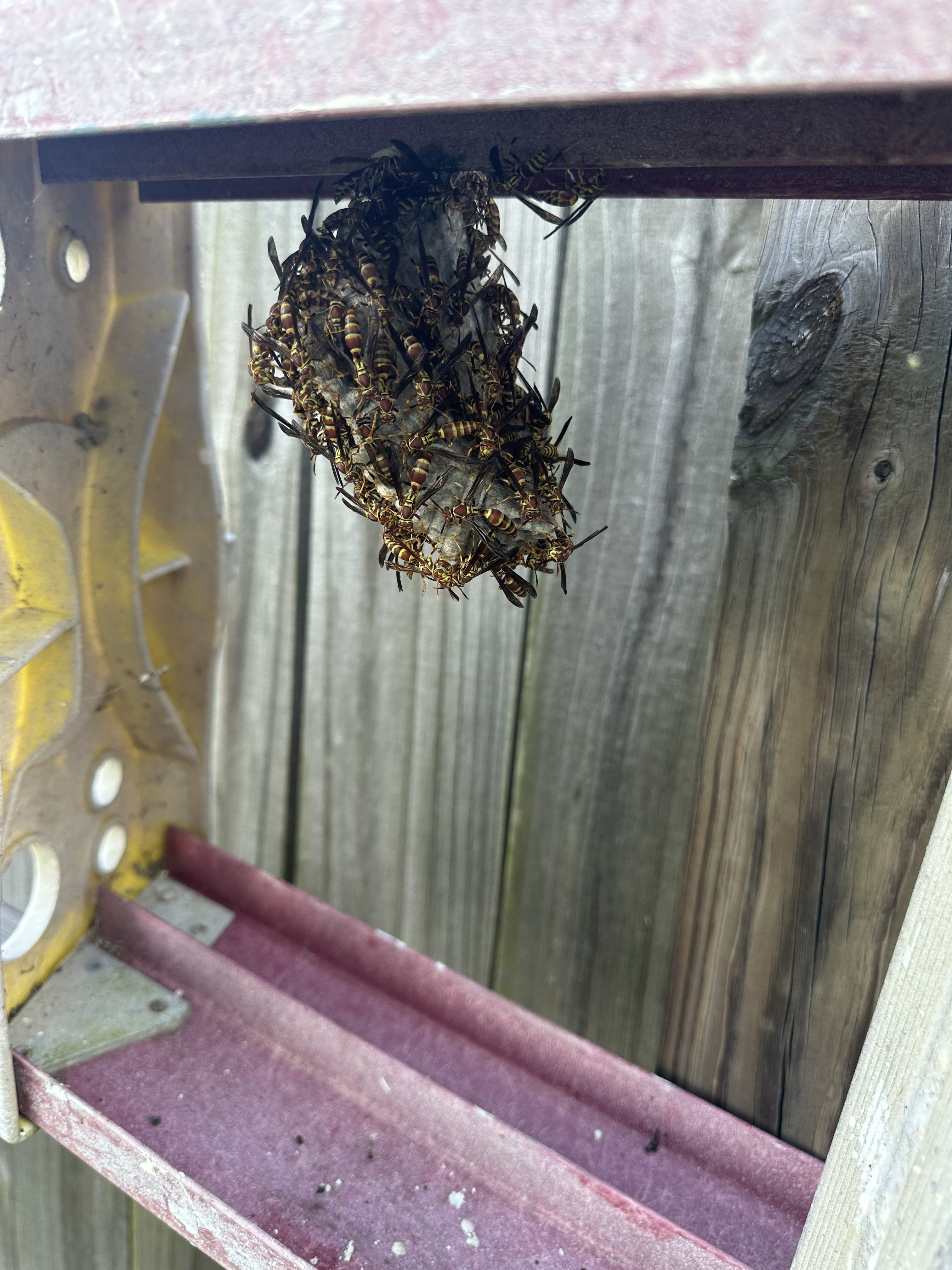
To a paper wasp, that folded umbrella can look like a protected little piece of real estate.
The same thing can happen underneath tables, behind shutters, beneath elevated flower pots, around sheds or inside other sheltered areas that aren't disturbed very often.
That's why simply spraying the area where you're seeing wasps isn't always the answer.
Sometimes you need to find out where they're actually coming from.
Why Are Wasps Hanging Around My Flowers?
Because flowers aren't just for bees and butterflies.
Adult paper wasps visit flowers for nectar. They can move pollen while they're doing it, although they're generally not the efficient pollinators we normally associate with bees.
They're also hunters.
Paper wasps prey on caterpillars and other insects to feed their developing larvae. From a homeowner's perspective, that means wasps aren't automatically “bad bugs” simply because they're present in the yard.
If they're minding their business on the other side of the property, there may not be much reason to bother them.
A nest three feet from where your kids get out of the swimming pool is a different conversation.
Location matters.
Why Pools Can Have So Much Wasp Activity
If you've ever wondered why wasps seem determined to ruin a perfectly good afternoon by the pool, there are several possible reasons.
They may be looking for water.
They may be visiting nearby flowering plants.
They may be hunting insects.
Or they may have found a protected nesting location somewhere around the pool area.
That's why I'd pay particular attention to repeated activity around umbrellas, outdoor furniture, fences, covered equipment and nearby structures.
One wasp getting a drink isn't the same thing as a steady stream of wasps disappearing into the same patio umbrella.
What About Those Hanging Wasp Traps?
I'm not against DIY pest control simply because it's DIY.
There are commercially available wasp traps that can be useful when they're being used for the insects they're designed to catch and placed appropriately.
But a trap is a tool — not an inspection.
If you've had a trap hanging for a week and you're catching little or nothing while wasps continue buzzing around the patio, don't automatically assume you need three more traps.
Take another look at what's happening.
What kind of wasp activity are you seeing?
Where are they spending their time?
Where is the trap located?
Are they repeatedly traveling somewhere else?
And most importantly, is there an active nest nearby that nobody has found?
Always follow the manufacturer's label and placement instructions for whatever trap or pesticide you're using.
When I'd Leave Them Alone
This might sound strange coming from a pest control company, but not every wasp needs to die.
Wasps are part of the environment. They're predators, they consume other insects, and adults can contribute to pollination while visiting flowers.
If I had occasional paper wasps working flowers at the back of my property and nobody was being bothered by them, I wouldn't automatically consider that a pest problem.
Pest control should solve a problem.
It shouldn't mean killing everything with six legs simply because we noticed it.
When I'd Start Paying Attention
My opinion changes when wasps begin conflicting with the way people use the property.
I'd take a closer look if you're seeing:
- Repeated traffic into the same opening
- An active nest that's continuing to grow
- Wasps around doors or walkways
- Nesting around a pool or patio
- Activity around children's play equipment
- Wasps regularly getting inside
- Activity coming from a soffit, wall or other structural opening
- Defensive behavior when people approach a particular area
That's when identifying the source becomes considerably more important.
One Thing I Wouldn't Recommend
Don't discover an active nest and immediately start taking things apart.
Moving the umbrella, pulling down a piece of siding, opening equipment or sticking your hand somewhere to “see what's in there” can turn a relatively calm situation into a very different one.
Observe from a safe distance.
If you can safely identify what's happening, great.
If reaching the nest requires putting yourself on a ladder, opening part of the structure or getting close to significant activity, that's a good point to consider calling somebody.
You Don't Have to Know What Species It Is
People will sometimes send me a picture and immediately ask:
“What kind of wasp is this?”
Identification can absolutely matter.
But as a homeowner, you can give me some extremely useful information without knowing the scientific name of anything.
Tell me:
Where are you seeing them?
How many?
What time of day?
Are they going into the same place?
Is there a visible nest?
Are they around flowers or water?
Are they behaving defensively?
That information starts painting a picture.
Sometimes the Best Pest Control Starts With Watching
A good inspection isn't just looking for bugs.
It's trying to understand what they're doing.
Wasps flying around your yard may be feeding, hunting, collecting water, looking for nesting locations or traveling back to a nest you haven't discovered yet.
Spend a few minutes watching before deciding what needs to happen.
You may realize there's no real problem at all.
Or you may notice that every wasp in the area seems to be disappearing into the same folded patio umbrella.
That's when you've learned something useful.
Need a Hand Figuring It Out?
Hilbun Pest Control provides pest control throughout South Alabama and South Louisiana.
When wasps are creating a problem around your home, we'll look at where the activity is occurring, what may be contributing to it and what actually needs to be addressed.
And if the answer is that something doesn't need to be treated, we'll tell you that too.
Hilbun Pest Control
Family-Owned Since 2007 | Veteran-Owned