
American Roaches vs. Asian Roaches vs. German Roaches: What's the Difference?
If you've found a cockroach in your home, one of the first questions you probably have is:
"What kind of roach is this?"
It's a great question because not all cockroaches behave the same way. In fact, identifying the species is one of the most important steps in determining the best treatment plan.
Along the Gulf Coast, the three species homeowners encounter most often are American cockroaches, Asian cockroaches, and German cockroaches. While they may look similar at first glance, each species has different habits, different preferred environments, and different treatment strategies.
At Hilbun Pest Control, one of the most common mistakes we see is homeowners assuming every cockroach is a German cockroach. Fortunately, that isn't always the case. In many situations, what appears to be a serious infestation may actually be a completely different species with a much simpler solution.
Let's take a closer look at each species and how to tell them apart.
American Cockroaches
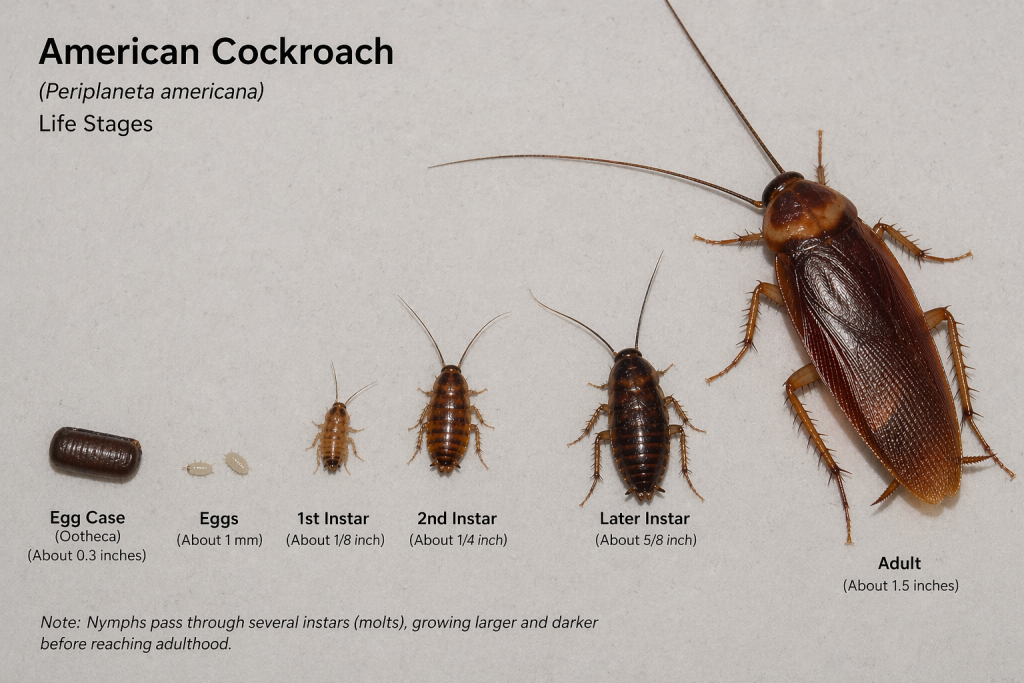
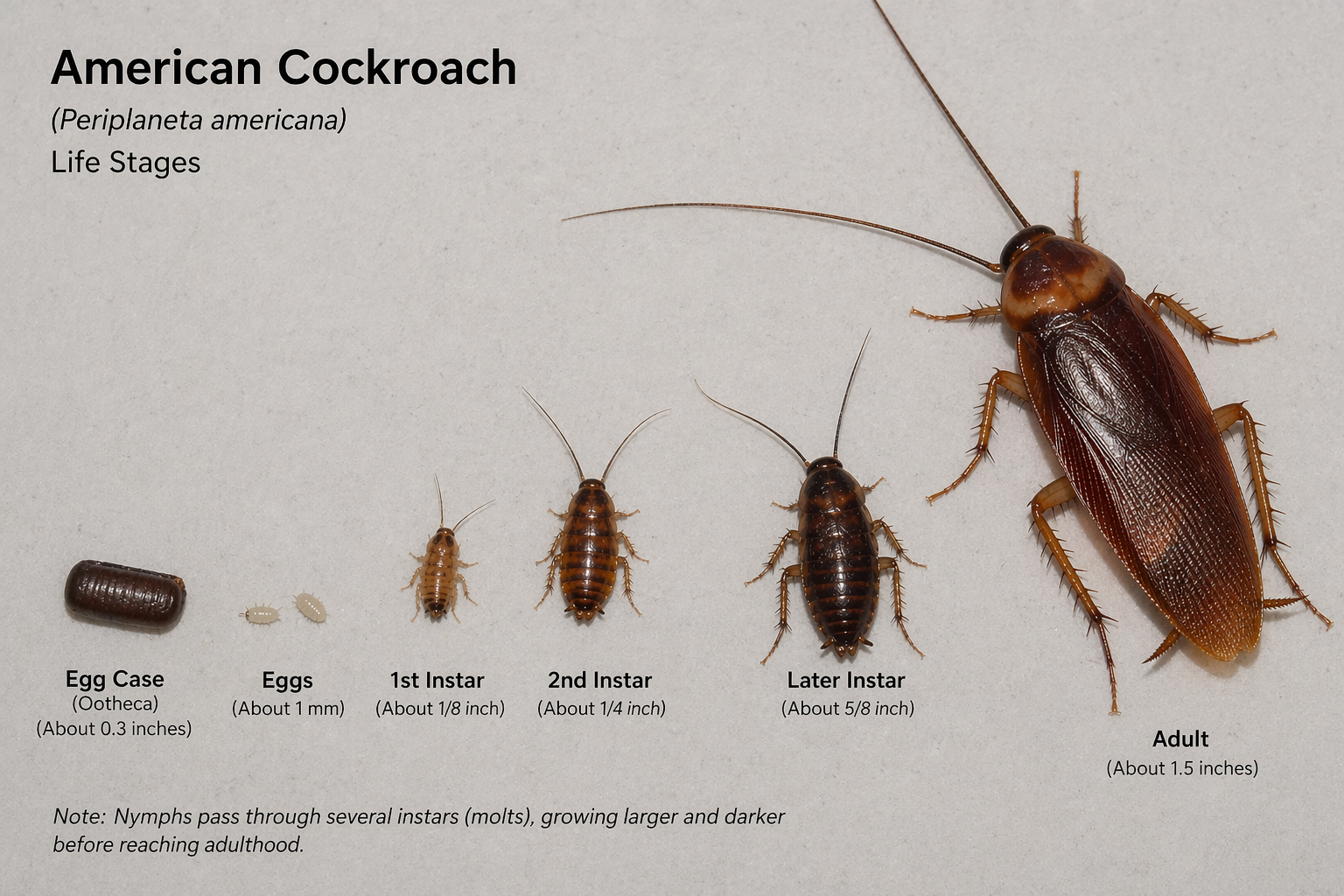
Often called Palmetto Bugs or Water Bugs, the American cockroach is the largest cockroach commonly found in homes throughout Alabama and Louisiana.
These insects typically measure 1½ to 2 inches long, have a reddish-brown body, and possess fully developed wings.
Although American cockroaches are capable of flying, they usually prefer to glide short distances or simply run when disturbed.
Unlike German cockroaches, American cockroaches rarely establish large indoor infestations. Instead, they typically live outdoors and accidentally enter homes while searching for food, moisture, or shelter.
American Cockroaches Commonly Live In:
- Crawl spaces
- Storm drains
- Sewers
- Mulch beds
- Leaf litter
- Landscape timbers
- Utility rooms
- Moist basements
- Around outdoor plumbing
Because they're strongly attracted to moisture, homeowners often discover them in bathrooms, laundry rooms, garages, or kitchens where plumbing penetrates the walls.
During periods of heavy rain, flooding, or extremely hot weather, American cockroaches are much more likely to move indoors.
Signs You May Have American Cockroaches
Unlike German cockroaches, American cockroaches usually appear one at a time.
Common signs include:
- Finding an occasional large cockroach inside the home.
- Cockroaches appearing in garages or utility rooms.
- Roaches entering through exterior doors.
- Increased activity after heavy rainfall.
- Seeing cockroaches around mulch beds or landscape areas.
If you're only seeing an occasional large cockroach every few weeks, you're probably not dealing with a German cockroach infestation.
How We Treat American Cockroaches
Since American cockroaches primarily live outdoors, the goal isn't simply treating inside the home.
Instead, we focus on reducing the outdoor population and preventing them from entering.
Treatment may include:
- Exterior perimeter treatments
- Landscape treatments around mulch beds
- Crack and crevice applications
- Moisture reduction recommendations
- Exclusion recommendations around doors and utility penetrations
- Interior treatment if activity is present inside
Treating the exterior often provides significantly better long-term results than only spraying inside the home.
Asian Cockroaches
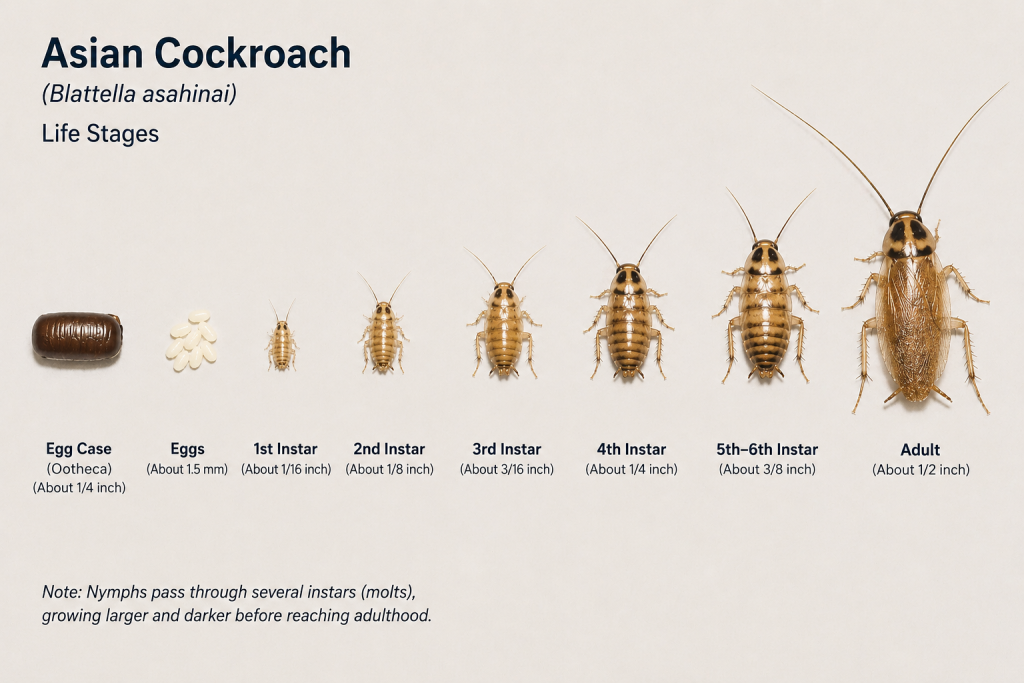
Asian cockroaches are one of the most misunderstood pests we encounter throughout South Alabama.
At first glance, they look almost identical to German cockroaches.
They're about the same size.
They're the same tan color.
They even have the same two dark stripes behind their head.
But that's where the similarities end.
Asian cockroaches are actually outdoor insects.
Unlike German cockroaches, they are excellent flyers and are strongly attracted to lights after sunset.
This is why many homeowners suddenly begin seeing dozens of small flying cockroaches around porch lights, garage lights, and windows during the warmer months.
Many people immediately assume they have a German cockroach infestation inside their home.
In reality, those cockroaches are often flying in from outside every evening.
Where Asian Cockroaches Live
Asian cockroaches thrive in:
- Mulch beds
- Pine straw
- Leaf litter
- Compost piles
- Dense landscaping
- Flower beds
- Wooded areas
They prefer moist organic material where they can hide during the day before becoming active at dusk.
Because they're such strong fliers, they frequently enter homes when doors are opened or when attracted to interior lighting.
Signs You Have Asian Cockroaches
Some of the biggest clues include:
- Small cockroaches flying toward porch lights.
- Roaches entering when doors are opened at night.
- Activity primarily after sunset.
- Numerous cockroaches outside but very few inside.
- Little or no evidence of breeding indoors.
One of the biggest clues is simple:
German cockroaches rarely fly. Asian cockroaches fly extremely well.
German Cockroaches
If American cockroaches are the largest and Asian cockroaches are the most misunderstood, German cockroaches are the species homeowners should take the most seriously.
German cockroaches are one of the most difficult household pests to eliminate because they spend nearly their entire lives indoors, reproduce extremely quickly, and hide in places that are difficult to access.
Unlike American and Asian cockroaches, German cockroaches are true indoor infestation pests.
If you find German cockroaches inside your home, they're almost always living there—not simply wandering in from outside.
How to Identify German Cockroaches
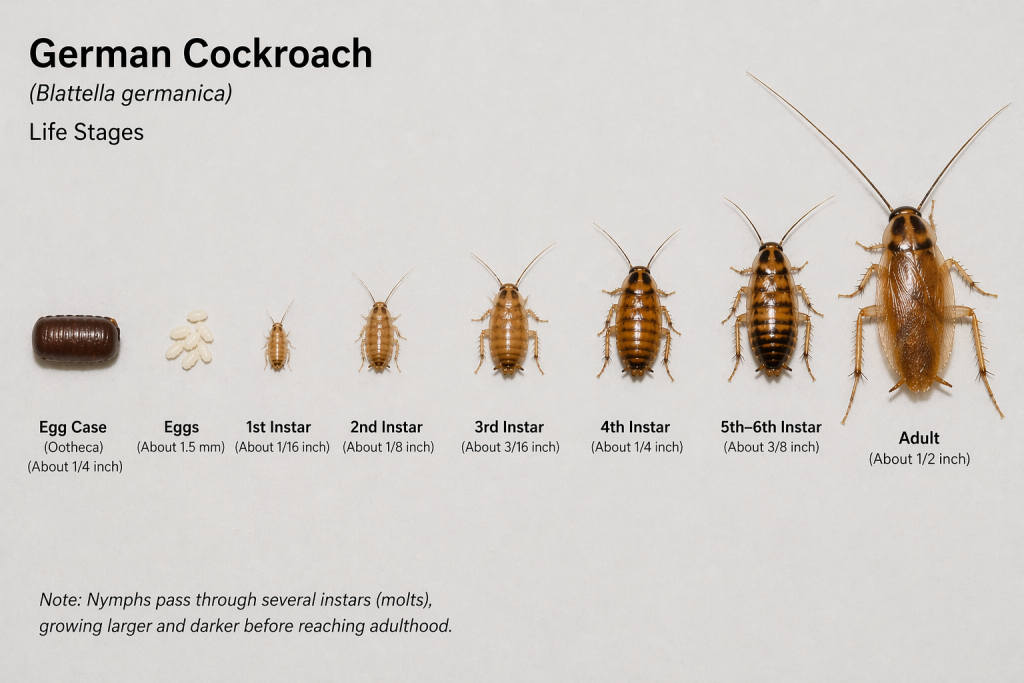
German cockroaches are much smaller than American cockroaches, usually measuring between ½ and ⅝ of an inch long.
They're light tan to light brown with two dark parallel stripes running behind their head.
Although they have wings, German cockroaches almost never fly.
Instead, they rely on running and hiding in tight cracks and crevices.
One female German cockroach can produce hundreds of offspring during her lifetime, which explains why small problems often become major infestations in a surprisingly short amount of time.
Where German Cockroaches Hide
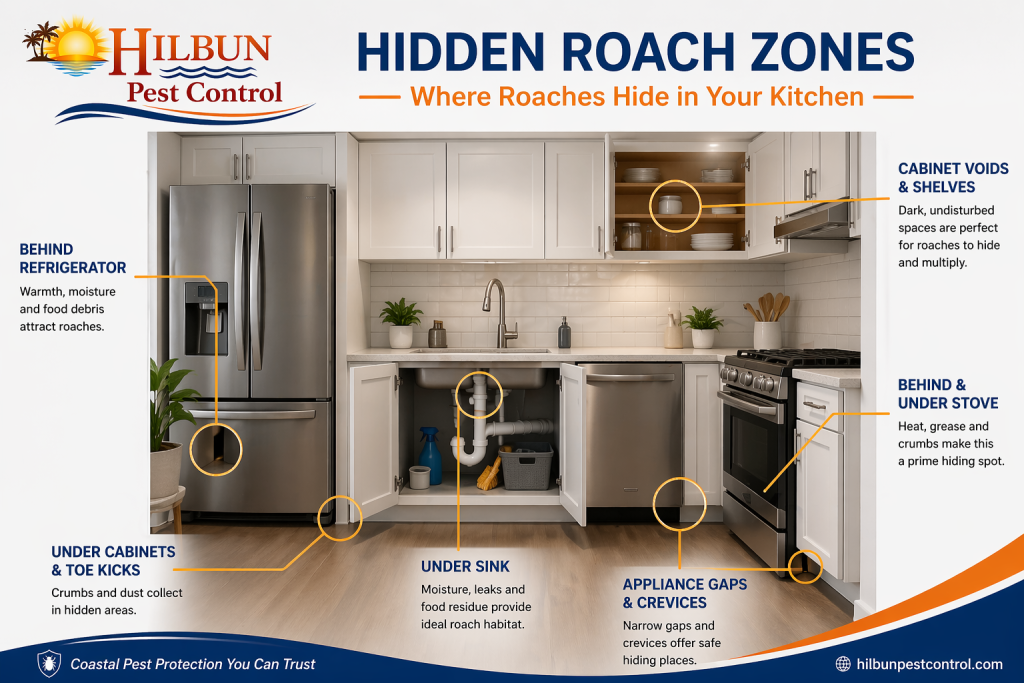
German cockroaches prefer warm, humid environments that provide easy access to food and water.
Some of their favorite hiding places include:
- Behind refrigerators
- Behind dishwashers
- Under kitchen sinks
- Behind stoves
- Inside cabinets
- Bathroom vanities
- Laundry rooms
- Wall voids
- Around plumbing penetrations
- Behind electrical outlets
Unlike American cockroaches, German cockroaches rarely wander far from their nesting sites.
If you're seeing them throughout multiple rooms, there's a good chance the infestation has already become established.
Signs You May Have German Cockroaches
Some of the most common signs include:
- Small cockroaches running when lights are turned on.
- Cockroaches found inside kitchen cabinets.
- Activity around appliances.
- Pepper-like droppings.
- Egg capsules (oothecae).
- Musty or oily odors in severe infestations.
- Seeing cockroaches during the daytime.
One of the biggest warning signs is seeing cockroaches during the day.
German cockroaches are naturally nocturnal.
If they're active during daylight hours, it often means the population has grown large enough that they're competing for food and hiding space.
Comparing the Three Species
At first glance, these three cockroaches can appear similar, but their behavior tells a completely different story.
One of the easiest ways to think about these three species is this:
American cockroaches usually come inside.
Asian cockroaches accidentally fly inside.
German cockroaches live inside.
Understanding that difference is one of the most important parts of developing an effective treatment plan.
Why Correct Identification Matters
One of the biggest mistakes homeowners make is assuming every cockroach problem should be treated the same way.
Unfortunately, that's simply not true.
For example:
If you have American cockroaches, treating the landscape, reducing moisture, and sealing entry points often produces excellent results.
If you have Asian cockroaches, focusing on outdoor harborage areas and reducing their attraction to exterior lighting can significantly reduce activity.
But if you have German cockroaches, neither of those approaches will solve the problem.
German cockroaches require a completely different strategy focused on eliminating the breeding population hidden inside the structure.
That's why identifying the species before treatment is so important.
Applying the right product in the wrong location often produces disappointing results.
Which Cockroach Is the Hardest to Eliminate?
Without question, German cockroaches.
They reproduce rapidly.
They hide exceptionally well.
They're capable of spreading throughout a structure.
And because they spend nearly their entire lives indoors, simply spraying around the outside of the home does very little to solve the problem.
American cockroaches, on the other hand, are generally much easier to manage because the majority of their population lives outdoors.
Asian cockroaches can certainly become a nuisance, but because they rarely establish breeding populations inside homes, controlling outdoor harborage areas is usually much more effective than treating the interior.
This is one of the reasons professional identification is so valuable.
What appears to be a severe infestation may actually be an outdoor issue—or vice versa.
How Hilbun Pest Control Treats Different Cockroach Species
One of the biggest misconceptions in pest control is that every cockroach problem can be solved the same way. The truth is, the most effective treatment depends entirely on the species you're dealing with.
At Hilbun Pest Control, we begin by identifying the cockroach species before recommending a treatment plan. This allows us to target the source of the problem instead of simply treating the symptoms.
American Cockroaches
Because American cockroaches primarily live outdoors, our goal is to reduce the exterior population before they find their way inside.
Depending on your property, treatment may include:
- Exterior perimeter treatments
- Landscape treatments around mulch beds and foundation plantings
- Crack and crevice applications around entry points
- Recommendations for reducing moisture around the home
- Interior treatment when activity is present indoors
For many homeowners, reducing the outdoor population dramatically decreases the number of cockroaches that make their way inside.
Asian Cockroaches
Asian cockroaches require a completely different strategy.
Since they rarely establish breeding populations inside homes, treating the interior often provides little benefit.
Instead, we focus on the outdoor areas where they live and breed.
This may include:
- Treating mulch beds
- Treating leaf litter
- Reducing harborage around landscaping
- Recommending exterior lighting changes when appropriate
- Creating a protective barrier around the home
Understanding their behavior is often the key to long-term control.
German Cockroaches
German cockroaches require the most aggressive and detailed treatment plan.
Because they reproduce rapidly and spend nearly their entire lives indoors, successful control often requires:
- Thorough inspections
- Crack and crevice treatments
- Targeted applications inside kitchens and bathrooms
- Insect Growth Regulators (IGRs)
- Follow-up inspections and treatments
- Sanitation recommendations
There isn't a "one and done" solution for most German cockroach infestations.
Instead, success comes from combining the right products with proper inspection, monitoring, and follow-up service.
Common DIY Mistakes
There's nothing wrong with trying to solve a minor pest problem yourself.
In fact, many homeowners successfully eliminate the occasional American cockroach.
However, there are a few mistakes we see over and over again.
Treating Before Identifying the Species
This is by far the biggest mistake.
Treating an Asian cockroach problem like a German cockroach infestation—or vice versa—often leads to frustration and wasted money.
Knowing what species you're dealing with should always come first.
Only Spraying Inside the Home
For American and Asian cockroaches, the majority of the population is usually outside.
If the source isn't addressed outdoors, new cockroaches will continue finding their way inside.
Expecting Instant Results
Professional products work differently than aerosol sprays.
Some products are designed to transfer between cockroaches or continue working over time.
Seeing occasional activity shortly after treatment doesn't necessarily mean the treatment failed.
Waiting Too Long
Cockroach problems almost always become easier—and less expensive—to solve when they're addressed early.
Waiting until you've seen dozens of cockroaches often means the population has had time to establish itself.
Frequently Asked Questions
Which cockroach is the most common along the Gulf Coast?
American and Asian cockroaches are extremely common throughout Alabama and Louisiana because of the warm, humid climate. German cockroaches are also common but are almost always associated with indoor infestations rather than outdoor environments.
Why do I only see cockroaches at night?
Cockroaches are naturally nocturnal and prefer to stay hidden during the day. If you're seeing them primarily after dark, that's normal behavior. Seeing large numbers during the daytime, however, can indicate a more established infestation.
Why do cockroaches come inside after it rains?
Heavy rainfall can flood outdoor hiding places and force cockroaches to search for drier shelter. This is one reason homeowners often notice an increase in American cockroach activity following periods of heavy rain.
Can one treatment eliminate every cockroach?
It depends on the species and the severity of the problem. While occasional invaders may be resolved quickly, established German cockroach infestations often require multiple treatments and follow-up visits to achieve the best results.
Should I save a cockroach if I find one?
Absolutely.
If possible, place it in a small container or take a clear photo before disposing of it. Proper identification allows us to recommend the most effective treatment plan and helps avoid treating the wrong species.
Final Thoughts
Not every cockroach is the same, and not every cockroach problem requires the same solution.
Understanding whether you're dealing with American, Asian, or German cockroaches is one of the most important steps toward successful control.
At Hilbun Pest Control, we don't believe in guessing.
We take the time to identify the species, inspect your property, explain what we're seeing, and recommend a treatment plan designed specifically for your situation. Whether you're dealing with the occasional American cockroach, outdoor Asian cockroaches, or a more challenging German cockroach infestation, our goal is to provide honest recommendations and effective, long-term solutions.
Need Help Identifying the Cockroach in Your Home?
If you're not sure what type of cockroach you're seeing, Hilbun Pest Control can help.
Our inspections are designed to identify the species, determine where the activity is coming from, and recommend the most effective treatment plan for your home or business.
Whether you're dealing with a single large American cockroach, flying Asian cockroaches around your porch lights, or a German cockroach infestation inside your kitchen, we're here to help.
Ready to get started?